Tuesday, 14 February 2017

Heanor, Langley Mill. Sandiacre, Shipley & Stanton by Dale Brickworks

Heanor

  Photographed at the Silk Mill Museum, Derby.

Under this Heanor heading I write about the two brickworks which where actually in Heanor, then the two works which are recorded as being in Marpool & Mill Hay/Milnhay. The maker of the Heanor brick above is unknown.

  © Crown Copyright. Reproduced with permission of NLS/Ordnance Survey 1880.

The 1880 map above shows that there where two brickworks in Heanor in that year with one situated on Nelson Street & one on Thorpes Road & recorded as Commonside in trade directories. I first start with the two brickmakers who are just listed as brickmaking in Heanor & these two makers could have been at either of these two yards at the dates that they are recorded in trade directories, so R. Marshall is listed in Kelly's 1855, White's 1857 & Kelly's 1864 edition & Ebenezer Howitt is just listed in Kelly's 1876 edition. I then found in White's 1857 edition that Gould, Checkland & Marshall are recorded as colliery proprietors at Marpool, so the brickmaker R. Marshall above could be the same Marshall in this partnership of owning a colliery at Marpool.

I. & W. Gillott are listed in Kelly's 1881 edition at Commonside (green coloured yard on the 1880 map above) & then as Gillott Brothers, Commonside in Kelly's 1891 edition. This yard is no longer shown on the 1898 map below & no named bricks have been found by any of the above brick makers unless the Heanor brick at the head of this entry can be credited to one of them. 


I have found two brickmakers with the name of Kemp in trade directories, one in Heanor & one in Ripley, so I do no not know which of these makers made this brick which I found at a reclamation yard at Pye Bridge. The trade directory listings are - William Kemp, Commonside, Heanor in Kelly's 1888 edition & Thomas Kemp, Greenwich, Ripley in Kelly's 1876 edition. The brick was on a pallet with other Ripley bricks, so Thomas Kemp is therefore my 1st choice, but William cannot be ruled out as maker of this brick, hence me adding this brick to this post as well as my Ripley Post. If I do get conformation of who made this brick, I will update both posts.

 © Crown Copyright. Reproduced with permission of NLS/Ordnance Survey 1898.

I now move on to the Nelson Street works in Heanor (coloured yellow on the map above) & Charles C. Fidler is listed at this yard in Kelly's 1881, 87 & 91 editions. Up to yet no bricks have turned up bearing his name. 

The partnership of Rigley & Claxton are next at this Nelson Street works & the first newspaper reference found to Rigley & Claxton appears in the Ripley & Heanor News dated 3rd October 1893. Rigley & Claxton are listed in Kelly's 1895 to 1900 editions at Nelson Street, Heanor. Kelly's 1904 edition just lists Alfred William Claxton at Nelson Street & two bricks made by R. & C. are shown below. The year this yard closed is unknown, but the 1913 map shows that Claxton Street is now built on the site of this brickworks. I have not been able to established who Mr. Rigley was in this partnership, but I write about Alfred William claxton next.

 Photographed at the Silk Mill Museum, Derby by Frank Lawson.


A family website has revealed that Alfred William Claxton aged 50 in the 1901 Census was born in Wrighton, Norfolk, trade - brickmaker/employer & was residing at 28 Nelson Road, Heanor together with his 2nd wife Hannah, one son & 6 daughters. At number 27 Nelson Street his son Arthur W. Claxton, aged 27, also born in Wrighton, Norfolk is recorded as a brickmaker & living at this address with his wife & daughter aged 1. The 1891 Census reveals that Arthur then aged 17 was living with his father Alfred, Alfred's second wife Hannah & their children at Station Street, Kirkby in Ashfield & Alfred is listed as brickmaker. There was a brickworks on Station Street next to the railway station which I have not been able to find who worked there & it strongly looks like Alfred may have been the owner or just the brickmaker at this Kirkby yard. The 1881 Census records Alfred as a labourer aged 30 & living on New Street, Kirkby with his first wife Ann, Arthur aged 7 & two daughters. Alfred's first wife Ann died in 1881 & he then married Hannah in 1882. I have established that Alfred & Ann had moved to Kirkby in 1875/6 because Arthur had been born in Norfolk in 1874 & their daughter Frances was born in Kirkby in 1876. 

I next found that A. Claxton & Sons are listed as brickmakers in Greenwich, Ripley as recorded in Kelly's 1916 edition, so could this A. Claxton be our Heanor duo, Alfred William Claxton & his son Arthur William Claxton or Arthur now with sons. I expect the 1921 Census will reveal if Alfred (now aged 66) & Arthur (now aged 47) were still brickmaking at in 1921. Alfred's great grand-daughter, Jean Hill has informed me that Alfred died on the 29th of September 1916 aged 66, so with the trade directory being published at the beginning of the year there is the option that it could still have been Alfred in this Ripley entry. Jean continues to tell me that Arthur died in 1972 aged 98. So we will have to wait until the 1921 Census is published to resolve this one. Updated June 2025. With now finding Arthur William Claxton is recorded as an Out of Work Colliery Banksman & still living on Nelson Street in Heanor in the 1921 Census I think I can safely discount him as being this A. Claxton, brickmaker at Ripley. I also note Arthur did not go on to have any sons. So another search of the 1921 Census has revealed this A. Claxton, brickmaker in Kelly's 1916 edition is Arthur's brother Alfred William Claxton junior b.1881, however in 1921 Alfred was working for the Butterley Brick Co. along with two of his sons, all listed as Brickworks Labourers & all living together on Wellington Street, Ripley, so I can only assume Alfred junior only briefly ran his own brickworks around 1916. His eldest son was only 13 in 1916, but may have still worked at the brickworks. Originally I hadn't considered Alfred junior as our Ripley brickmaker with him being listed as a Farm Labourer in the 1911 census & still living in Heanor. To round off this entry I have added the 1913 OS map below showing Alfred junior's works in Greenwich, Ripley which was at the end of Victoria Street. Bricks stamped Claxton, Ripley are still to be found.

© Crown Copyright. Reproduced with permission of NLS/Ordnance Survey 1913.


Timothy Butler is listed as brickmaker in Kelly's 1855 edition at Marpool, Heanor. The earliest map that I have available was surveyed in 1879 & with this map not showing any brick yards at this date I am unable to tell you the location of Tim's yard. 

   Photo by MF courtesy of Phil Sparham Collection. 

I first have note that the spelling of Milhay as stamped on this brick is actually Milnhay today & the 1879 map & White's 1857 trade directory both record this hamlet as Mill Hay. 

White's 1857 edition lists the Patent Brickworks, Mill Hay with J.F. Milnes as manager & fellow collector Frank Lawson has obtained this information from the Heanor Local History Society - Millhay brickworks was associated with Millhay Colliery at Langley Mill & was owned by Smith & Goodwin, with the colliery closing in 1856. Further digging around on the web has revealed that Smith & Goodwin owned the Langley Mill Pottery on Station Road & Mill Hay Colliery was next to the pottery from 1847 to 1856. So this brick could have been made at S & G's pottery works, but I cannot rule out the option that there could have been a brickworks at the side of the colliery as well, also owned by Smith & Goodwin. 

So it appears that this brickworks/colliery was not in Mill Hay, but actually in Langley Mill & just named after that hamlet with the colliery being situated opposite the road which went to Millhay. I have used the 1879 map below to show the location of the Langley Mill Pottery/colliery site. Today this former pottery/colliery site is occupied by the Acorn shopping centre. 

After writing the last paragraph a new discovery on the web from a list of mines which closed in 1857 records that the Mill Hay Colliery closed in that year & the owners are listed as McAlum & Allen. Now I have brick (shown in the Langley Mill entry) stamped McCallum & Co. & this company is listed as McCallum & Allen in the 1855 & 57 trade directories. So this new info now disagrees with the information Frank obtained from the Heanor History Society. I am not saying that this information Frank received is incorrect as there is the option that Smith & Goodwin owned the colliery before McCallum & Allen in 1855 with the colliery being sunk in 1847. Only more research will resolve this quandary.

I now believe I have now found the Smith & Goodwin connection of them owning Mill Hay Colliery. There was a second pit on this site next to pottery in 1874. It must have been short lived as the pit is not shown as such on the 1879 map. The mining reference that I found it in states that "the pit (not named) was near the Pottery offices" & Smith & Goodwin's names are given as owners of the pit. So hopefully that has sorted this quandary & the information given to Frank by the Heanor Local History Society is correct. I have just got to establish who made the Milhay brick, Smith & Goodwin or McCallum & Allen & if it was S & G was it at their Pottery Works or was there brickworks at the side of the pit in 1874 - Simples !!!

 © Crown Copyright. Reproduced with permission of NLS/Ordnance Survey 1879.


Langley Mill

Old maps show that there where two brickworks in Langley Mill & I have found many brickmakers listed in trade directories, but only with Langley Mill as the location of their works, so I am unsure in some cases who worked at which yard. There was a third brickworks next to Langley Mill Pottery on Station Road, but this works is not shown as such on any of the maps that I have access to - (coloured red on the 1879 map below). John Beardsley is listed at Aldercar Lane, so I am certain that he owned the works which was accessed off Cromford Road (yellow on map below). I have also attributed this same works as later being owned by the Langley Mill Brick Co. The 1899 map shows this works (yellow) was the larger in size of the two & I am then taking it that the smaller works (green) was being run by Charles Hardy, who was working on his own.

© Crown Copyright. Reproduced with permission of NLS/Ordnance Survey 1879.

 © Crown Copyright. Reproduced with permission of NLS/Ordnance Survey 1879.

I have had to use two 1879 maps to show both of these Langley Mill brickworks & the bottom of the first map joins the top of the second. I was hoping that I could line these two maps together, but they do not quite match.

As said, because I have two works & several brickmakers & I do not known for certain who operated which yard, I have listed each of the brickmakers/companies in date order with the yard that they may have owned if known. 

As I only have one photo of a brick made by any of these makers I start with McCallum & Allen who are listed in Kelly's 1855 & White's 1857 editions at the Patent Steam Brick, Pipe & Terra Cotta Works, Langley Mill. Searching the web has revealed that in a list of mines which closed in 1857, Mill Hay Colliery is in that list & the owners are recorded as McAlum & Allen. I am taking it that McCallum's name had been just been mis-spelt. Mill Hay Colliery was situated on Station Road next to Langley Mill Pottery, the location of which can be seen on the 1879 map above (coloured red). White's 1857 edition also records that J.F. Milnes is listed as manager at the Patent Brickworks, Mill Hay & this ties in with the McCallum & Allen 1857 trade directory entry as owners of the Patent Steam Brickworks. 

  Photographed at the Silk Mill Museum.

Kelly's 1855 edition records Woodward & Horsefield at Heanor, then the couple are listed at Langley Mill in White's 1857 edition. I think that this Heanor listing is still their Langley Mill yard as I have found in many trade directory listings that Langley Mill is listed first then Heanor second in the addresses of trades persons working in Langley Mill.

From the Ilkeston Pioneer newspaper I have a notice & an advert for the Erewash Valley Patent Brick, Pipe & Tile Co. The notice from June 1853 states that a new brickworks was going to open in Langley Mill with the capacity to produce 20,000 bricks per day when in full production. The May 1854 advert states "On sale & ready for delivery, common bricks, first rate pressed frontage bricks, hexagonal & square floor bricks, pantiles of all types & drainage pipes of all sizes. All orders executed on the shortest of notice. Any amounts delivered to Nottingham, Derby, Mansfield & any intermediate Stations at advantageous rates". Apply Joseph Tomlinson, Manager of the Works, Langley Mill Station. Neither the notice or the advert actually states which of the two brick works it was in Langley Mill as both works had there own sidings, but I am favouring the one nearest the railway station off North Street (coloured green on the 1879 map below). There are no listings for the Erewash Valley Patent B. P. & T Co. at Langley Mill in trade directories & how long this company operated in Langley Mill is unknown, but I have found another company called the Erewash Valley Brick, Pipe & Pottery Co. Ltd. & is listed in Kelly's Notts. 1900 edition at Newthorpe, however there is no connection between these two companies. This Langley Mill works was then taken over by Charles Hardy in 1899 & I write about Charles a little further down this entry. 

John Beardsley is listed at Aldercar Lane, Heanor (again Aldercar Lane is in Langley Mill) in Kelly's 1876 edition. Then John is listed in Kelly's 1881 & 87 editions at Langley Mill. The London Gazette & a newspaper article records John Beardsley went bankrupt in April 1887. So I am crediting the yellow works to John Beardsley who also owned a coal mine leased from the Duke of Newcastle in Brinsley. As of yet, no bricks stamped J. Beardsley have turned up. There were two brickmakers with the name of Beardsley operating in Ilkeston & although I have not found any connections, John may have been related to one of them.

Clarke & Son are listed in Kelly's 1891 edition at Langley Mill.

Kelly's 1899 to 1912 editions lists the Langley Mill Brick Co. Ltd. Langley Mill. I have credited the yellow works to this company.

Charles Hardy is listed in Kelly's 1899 to 1900 editions at Langley Mill, then the 1904 & 1912 editions list C.W. Hardy at Langley Mill. I have credited the green works situated off North Street as being owned by Charles.

© Crown Copyright. Reproduced with permission of NLS/Ordnance Survey 1900.
This 1900 map now shows that both brickworks have expanded in size. Today the green yard accessed via North Street is an industrial estate & the yellow yard is now housing on Crown Way.

I now write about the two brickmakers who are listed at Langley, Heanor & these are W. Spray in Kelly's 1864 & White's 1857 edition, then Levi Spray in White's 1857 edition. I do not have any maps covering these dates to show you their yard & the 1879 map does not show any brickyards in Langley.


Sandiacre

© Crown Copyright. Reproduced with permission of NLS/Ordnance Survey 1880.

My first trade directory listing for a brickmaker working in Sandiacre is R. Salt who appears in Kelly's 1855 edition & Salt's yard was more than likely the one on Bostocks Lane (coloured yellow on the 1880 map above). This Bostocks Lane yard was then owned by the Sandiacre Brick Co., then John Saunders & finally T. Sellars before closing in the mid 1890's & I write about each brickmaker in turn.

The brick kilns (coloured green) on the 1880 map above where at the Sandiacre Wagon Works. It appears from this map that the brickworks was established to produced the bricks needed for the building of this wagon works which was designed & laid out by Daniel  Macnee in 1877 & may have been owned by Edward Eastwood who is listed as waggon builder at Sandiacre in Kelly's 1891 edition.

 Photo by Frank Lawson.

This brick was made by the Sandiacre Brick Co. & although not named as such in Wright's 1874 trade directory, the making of bricks, lace & starch products are listed as being produced in the village. This brick yard is coloured yellow on the 1880 map above & my next reference to the Sandiacre Brick Co. comes from the London Gazette dated 28th May 1875 when the company was voluntarily wound up. We next find that John Saunders was the next owner of this works, possibly not long after 1875 & featured below is one of his bricks which was produced using the latest patented steam machinery.   

Photo by Frank Lawson.

This Bostock Lane works under the ownership of John Saunders did not last very long as we next find in a notice which appeared in the Ilkeston Pioneer newspaper in 1882, declars the Sale of the Brick & Tile Works at Sandiacre & reads - This works is being sold by Mr. Thomas Neale at his mart on Wheelergate, Nottingham on Wednesday 9th August 1882 at four o’clock precisely on behalf of the Mortgagee. The notice then goes on to list all the Plant that was for sale & this included three kilns, extensive steam-heated drying sheds, stable, office, steam engine & boiler, complete steam brickmaking machinery, an elevated tramway to the mill giving easy access to the Erewash Canal (the canal at this point was actually the Derby Canal according to the 1880 map above). The machinery has been put down (purchased & set up) at great cost by Mr. John Saunders & is in good working order & of best of it's kind. The bed of clay is practically inexhaustible & best in the neighbourhood. Bricks made are much sought after. I think the person who wrote this notice would make an excellent spin doctor today ! The notice continues with the listing of land which has been divided into 56 plots & to be sold for housing, each plot varying from 800 to 1000 square yards. The proximity to the brickworks would materially cheapen the cost of building the houses. So it appears that from this notice of the sale of the works, John Saunders had not kept up on the repayments on his mortgage & the Mortgagee was selling the works to recoup their losses. 

We next find that T. Sellers is the new owner of this works as recorded in Kelly’s 1887 edition & two examples of his bricks can be seen below. The first using the same designed frog as the one used by Saunders with Sellars continuing to call his works "The Red & White Brick Works.
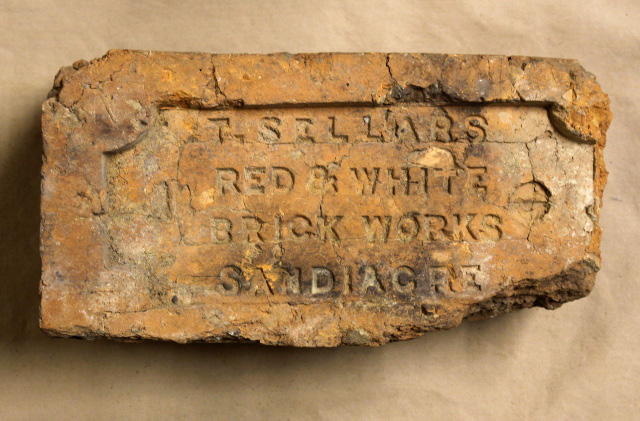
Photographed at the Silk Mill Museum, Derby.

The 1898 map below shows this works is now disused, so Sellars was only at this yard for a few short years also. The in-exhaustable clay reserves as recorded in the 1882 Sale of the Works Notice appears not to have been used. Also the plan to build 56 houses next to the brickworks does not appear to have materialised either. Bostock Lane in places now follows a slightly different route today to the one shown on the 1898 map below & houses have now been built on this former brickworks site with the traffic on the M1 gently roaring-by sandwiched in-between these houses & Wilsthorpe Lodge Farm. This farm house & buildings are shown as being in the same location on the 1898 map below & today the farm has access off Bostock Lane via it's own bridge over the M1.

© Crown Copyright. Reproduced with permission of NLS/Ordnance Survey 1898.


Shipley

© Crown Copyright. Reproduced with permission of NLS/Ordnance Survey 1900.

There are no trade directory entries for this brickworks which was located next to the Nuthall Canal at Shipley Wharf. With it being situated very close to Shipley Hall, this brickworks I believe was an estate brickworks owned by the Miller-Mundy family who lived at the Hall. The family are recorded as owning Shipley Colliery which consisted of two pits - Coppice & Woodside. I have found on the web that this brickworks was operational between 1880 & 1914 & this is backed up with the works being shown on the 1879 map as a brick yard & then not shown at all on the 1913 map. Not even the outline of the clay pit is shown on the 1913 map which can be clearly seen on the 1899 map above, so the clay pit must have been filled in by 1913.

  Photo by Frank Lawson.
The lettering on this Shipley brick indicates that this is a pre 1900 brick. Frank photographed this brick in situ on top of a wall in Marpool, so only a stones throw from where it was made. I then added this next example to my collection in 2024. 


I photographed this blue brick on a farm in Sutton in Ashfield & I expect that the company with finding that there was another brick company in Shipley, Yorkshire making bricks they decided to add Derby to their bricks.

Photo by Mick Farmer.

With Mick finding this one in his garden, it certainly will have been made in Derbyshire & more than likely pre-dates the Shipley, Derbys blue brick above.


Stanton by Dale

© Crown Copyright. Reproduced with permission of NLS/Ordnance Survey 1880.

T. Gillott is listed as brickmaker in Kelly's 1855 edition at Stanton by Dale. I do not have a map from that year to show Gillott's yard & the nearby Stantongate yard on the 1880 map above may have been his yard in 1855. Stanton by Dale is just off to the left on this map & no brick yards are shown actually in this village, hence my thought's that Gillott's yard was this yard at Stantongate next to the canal & railway station. As you can see this was an ideal location for a brick yard with the canal, roads, railway, coal pits & clay all on hand to produce & distribute bricks. 
This brick yard is still shown on the 1898 map & from the 1871 Census Joseph Blackwell aged 63 & his son John aged 20 are recorded as brickmakers at Stanton by Dale.

Gillott rev. Stanton, photographed at the Silk Mill Museum, Derby.


I wish to Thank the following :-

Frank Lawson
Silk Mill Museum, Derby
Heanor Local History Society
NLS/Ordnance Survey
Ilkeston Library
Phil Sparham


Wednesday, 25 January 2017

Ilkeston Brickworks

Poundall

 Photographed by MF at the Silk Mill Museum, Derby.

Ulysses Poundall is listed as brickmaker at Cotmanhay in Kelly's 1855 edition. I also have a reference to Ulysses owning a beerhouse called the Brick & Tile Inn in Cotmanhay in White's 1857 edition. I have found on several occasions that brickmaking & being a beerhouse owner/seller of beer went hand in hand. The location of his yard is unknown, but the 1879 map as shown in the Horridge entry shows two yards (yellow & blue) on the edge of Cotmanhay & he may have owned the yellow coloured yard as William Horridge owned the blue coloured yard in 1855. This yellow coloured yard was then owned by William Beardsley in 1876 & I write about him later.


Horridge, Cotmanhay & Ilkeston


Photographed by Frank Lawson at the Silk Mill Museum, Derby.

With the help of Matt Horridge we have established there were 8 brickmakers with the name Horridge in the Cotmanhay/Ilkeston area & I have created a Horridge Tree to show their family connection. As Jonathan senior died before the 1841 census I have not been able to ascertain his profession. By following the rest of Jonathan's descendants in the census I have found if they were not brickmaking they worked as lace makers, cloth weavers or coopers.


So I start with William Horridge & his three sons James, Samuel & Joseph & the W H C brick above may have been made by William Horridge of Cotmanhay, but I have to note since photographing a West Hallam Colliery brick (4.7.17) this initialled WHC brick could have been made at the colliery instead.  

William Horridge b.1879 married Hannah Barton & they had 4 sons & 5 daughters. William is listed in Glover's 1827 edition as brickmaker & farmer. The 1841 census records William, sons James b.1811, Samuel b.1819 & Joseph b.1824 all as brickmakers in Ilkeston. I am assuming William's three sons were all working alongside him at his Cotmanhay yard.

In the 1851 census William is listed only as a brickmaker aged 71 & living at Middle Common. In August 1855 the Horridge family are recorded as living at 6, Horridge Street & Kelly's 1855 edition records William was still brickmaking at Cotmanhay. The 1861 census reveals William was still a brickmaker so he must have been made of stern stuff to still be brickmaking at the age of 81. William died on the 21st of May 1863. We also find son James had died in 1859.

In the 1851 Census at the same address his son Samuel b.1819 aged 30 is also listed as a brickmaker. Samuel is still listed as a brickmaker in the 1861 census & living with his wife Elizabeth at his mother-in-laws house on Heanor Road. Kelly's 1864 edition records Samuel as a brickmaker in Cotmanhay, therefore we know from this entry that Samuel had taken over the running of his father's brick yard after his death in 1863 & more than likely Joseph was still working alongside him. In the 1871 census Samuel is again listed as a brickmaker, but now a widower. 

I have coloured Horridge's brickworks blue on the 1879 OS map below. I have deduced the yellow coloured works was operated by the Beardsley family because this yard is no longer shown on the 1899 map & the Beardsley's last trade directory entry is 1887. However the blue coloured yard is still shown on the 1899 map & this ties in with trade directory entries for Joseph Horridge still operating this blue coloured yard in 1900. 

 © Crown Copyright. Reproduced by permission of NLS/Ordnance Survey 1879.

Now on to William's son, Joseph Horridge b.1824 & he is recorded as brickmaker aged 37, a widower & living with his father William in the 1861 census. As wrote Joseph's brother Samuel is listed in the 1864 directory as operating the Cotmanhay yard & in Kelly's 1876 to 1900 editions we find Joseph is now recorded as the owner of this yard. Further investigation has revealed William died on the 4th of August 1873 aged 54 & it will have been at this date Joseph took over the running of the Cotmanhay yard. I believe this Cotmanhay yard closed shortly after 1900 with Joseph now 76 retiring from brickmaking. Joseph died in January 1909. 


It appears the W for William has been removed from the plate which made this Horridge brick so I expect it was made by Samuel or Joseph after 1863.

Now on to the second branch of Jonathan Horridge senior's brickmaking family lead by Jonathan junior b.1799, who was followed into the trade by his sons William b.1823 & Thomas b.1828  & then by Thomas' son Arthur who joined his father in the late 1870's. It is unknown which brickyard Johnathan junior worked at as there are no trade directory entries for him actually running his own yard. Then after being employed at different yards in Ilkeston sons William & Thomas then operated three yards of their own, one was situated on Ilkeston Common/Awsworth Road, the second was just off Nottingham Road near the Gallows Inn & the third was in Heanor. Up to yet no Horridge bricks have been found stamped with these four brickmakers first names.

Jonathan junior married Martha Bamford b.1800 on the 24th of May 1818 & they produced 2 boys & 5 girls before Martha's untimely death in May 1833. Johnathan then married Elizabeth Buxton nee Henshaw in 1833 & the couple produce three more children. In the 1841 census Jonathan aged 42, William aged 18 & Thomas aged 15 are all listed as brickmakers. Where they were all brickmaking at this date is unknown. Jonathan died aged 46 in 1845. From Matt Horridge's research I have to note that Jonathan junior's brother John born 1781, a hand loom weaver was married to another Martha Bamford who was born in 1786 & they had one son & three daughters. I bring this to your attention because several family website trees have mixed these two Martha's up & added some of Jonathan's children to John's branch, which is wrong.

I now move on to William Horridge b.1823 who is recorded in the 1851 census as a Brickmaker & Beer Seller living on Chapel Street, Ilkeston. A notice in the Ilkeston Pioneer dated 18th February 1858 records that William Horridge who had been manager at Potters brickyard for many years had purchased James Tomlinson's yard at Ilkeston Common & he was advertising that he could manufacture & supply high quality bricks from this works. William is recorded in Slater's 1863 edition at Ilkeston Common. From information found I have established that Ilkeston Common lay along side the Erewash Canal between Ilkeston & Cotmanhay. This Ilkeston Common yard was to be later run by his brother Thomas Horridge & I have coloured this yard green on the 1879 map below which was situated off Awsworth Road & next to the canal. I have to note that I have pieced this information of the location of Ilkeston Common & this yard from several sources, so I hope that what I have written is correct as there are no more brick yards shown on old maps which match up to being situated on Ilkeston Common.

  © Crown Copyright. Reproduced by permission of NLS/Ordnance Survey 1879.

William continues to be listed as a brickmaker in the 61, 71, 81 & 91 census. I now bring his brother Thomas into play & Thomas b.1828 is listed in the 1851 census as a brickmaker & lodging with his future mother-in-law Mrs. Mary Sisson (b.1797) in Ilkeston. Where Thomas was brickmaking in 1851 is unknown, but I am assuming that Thomas joined his brother William at the Ilkeston Common brick yard after William had purchased it in 1858. The 1861 census now records Thomas had married Phoebe Sisson & they were living on the Twitchell, Ilkeston. The couple went on to have three daughters & one son Arthur, who was born in 1863. Phoebe died in 1864 & Thomas then married Mary Sisson (b.1834) in 1865. Thomas & Mary are listed in the 1871 census with Thomas' children & one new son Thomas junior. I checked to see if Phoebe Sisson & Mary Sisson were sisters, but found no connection of them being sisters, so they may have been cousins.  

I next found an advert in the Ilkeston Pioneer newspaper dated 23rd of February 1871 giving notice of "Sale of Plant" by W. & T. Horridge, so I am assuming William & Thomas were going their separate ways. However trade directories reveal Thomas continued to run the Ilkeston Common brickworks with him being listed in Kelly's 1876 & 1881 editions as owning a brickworks on Awsworth Road (Ilkeston Common). The 1881 census records brickmaker Thomas, wife Mary & their 6 children were living on Awsworth Road & son Arthur aged 18 was now a brickmaker, so I am assuming he was working alongside his father. Kelly's 1887 & 1891 editions now record that the Horridge's were running a second works on Nottingham Road (Gallows Inn, Ilkeston) as well as their Awsworth Road works. The 1891 census records the Horridge family still living on Awsworth Road with Thomas & Arthur (still single) listed as brickmakers. The exact year Thomas & Arthur finished brickmaking is unknown, but it may have been just before 1895 when Thomas Benniston is recorded as owning the Nottingham Road Works. It is unknown what year the Awsworth Road works closed, but may have also been in 1895. With the 1901 census recording Thomas' wife Mary as a Widow, Matt Horridge has informed me that Thomas died on the 6th of July 1897.  My next search was for the whereabouts of Arthur & what he was doing in 1901 & I have found a Arthur Horridge of the right age born in 1863 & listed as a Cemetery Superintendent living in Ilkeston with his wife Sarah, 2 boys & 2 girls ranging from 1 to 7. Matt Horridge has confirmed I have found the correct Arthur & he had married Sarah in 1891 after the 1891 census which records him still at home & single. 

 © Crown Copyright. Reproduced by permission of NLS/Ordnance Survey 1880.

The 1880 OS map above shows three brickworks off Nottingham Road at Gallows Inn & I have established that the blue coloured yard was owned by the Erewash Ironworks Co. & was operational between 1880 & 1900. The green coloured works was owned by Isaac Wilson & John Wilson & then by the Cordon Brothers. So this leaves the yellow works as being owned by Thomas Horridge as recorded in Kelly's 1887 & 1891 editions. This yellow works had been owned by Mathew Hobson in 1882 & listed as Hallam Fields. I write about Mathew Hobson next. 

After Thomas Horridge had finished at this yellow coloured yard trade directories record Thomas Benniston had taken over this works by 1895 & he was the proprietor of the Gallows Inn Brick & Tile Company & write about him later in the post. 

Going back to Thomas' brother William Horridge & after they had gone their separate ways in the early 1870's William continues to be a listed as a brickmaker in the 1881 & 1891 census. I then found an advert in the Ilkeston Pioneer newspaper dated 28th August 1879 which exclaims with the heading of Bricks! Bricks! & the announcement that William Horridge now rents Tutin's brickyard, Ilkeston & is preparing to supply bricks by rail or land & these bricks were to be sold at market prices. So where was Tutin's brickyard situated in Ilkeston ? The 1881 census records William was living on Awsworth Road, but by the 1891 census he was living on Lacey Fields Road, Heanor with his daughter Georgina aged 28. A search for Lacey Fields Road has revealed this road was in Langley, Heanor, north of Ilkeston. Maps also show Lacey Fields Farm & near to this farm on the 1899 OS map there is a disused clay pit which was accessed from Lacey Fields Road, so with these findings they indicate Tutin's yard was in Langley, Heanor & not Ilkeston & William was running it up to & shortly after the 1891 census with him still being recorded as a brickmaker aged 67. I have not been able to find William in the 1901 census, but Matt Horridge has informed me that he died in July 1904. Many Thanks Matt for the info you have sent me which fills in many blanks. Matt is a descendant of another of Jonathan senior's sons, Thomas born 1793.  


M.Hobson


Photo by MF courtesy of Erewash Museum, Ilkeston.

Wright's 1882 edition records Mathew Hobson as farmer & brick maker at Hallam Fields & his yard is the one which I have coloured yellow on the 1880 map below. White's 1857 edition records Mathew as farmer & living at Field House, Ilkeston, (also shown on the map below in yellow). So it appears that Mathew took up brickmaking around 1882 & his yard was not to far from where he lived & farmed. This yard was then taken over by Thomas Horridge in 1887.

 © Crown Copyright. Reproduced by permission of NLS/Ordnance Survey 1880.

Photo by MF courtesy of the Andy Mcauley Collection at the Marlpool Brewing Co. 


Tomlinson, Ilkeston


  Tomlinson rev. Ilkeston brick photographed at the Silk Mill Museum, Derby by Frank Lawson.

Finding info for this Tomlinson/Ilkeston brick had eluded me as I had found no trade directory entries in this name at Ilkeston, Tomlinson's in Derby yes, but none in Ilkeston. I then found the answer in a Ilkeston Pioneer newspaper at Ilkeston Library dated 18.2.1858. It was a notice by William Horridge announcing that he had taken over James Tomlinson's yard at Ilkeston Common & he was advertising that he could manufacture & supply high quality bricks from this works. It was then a case of establishing the location of Ilkeston Common. It was from a very old map that revealed that Ilkeston Common was situated between Cotmanhay & Ilkeston with Bennerley Bridge over the canal on the northern edge of the Common. So on the 1879 map below, I have coloured James yard green & Bennerley bridge is where it says Bridge Street near to the top of the map with Bennerley Colliery on the other side of the canal. A second reference to the location of this works comes from Thomas Horridge's 1876 listing as owning the same brick yard, but listed as Awsworth Road. So with all this information, I have established that James Tomlinson made his bricks at this yard on the Common before 1858, but not as early as 1855 because James is not listed in Kelly's 1855 trade directory.

 © Crown Copyright. Reproduced by permission of NLS/Ordnance Survey 1879.


Wilson - Cordon Brothers


Wilson/Ilkeston brick photographed at Silk Mill Museum, Derby by Frank Lawson.

I have a choice of two brickmakers by the name of Wilson who made this brick. Isaac Wilson is listed in Kelly's 1849 & 1855 editions at Nottingham Road, Ilkeston, then in White's 1857 edition Isaac is listed at Gallows Inn. Harrison's 1860 edition also lists Isaac at Gallows Inn. Kelly's 1864 edition then lists John Wilson on Nottingham Road. So John could be Isaac's son or brother. I have established from a 1875 newspaper advert that the Wilson's owned the green coloured yard on Nottingham Road & named as the Gallows Inn Works (brick) on the 1880 map below.


Found this tile at Fletcher's Reclamation yard in Spondon in May 2021. There was only this one example, hence me having to stick it together with super-glue. Below is a smooth faced paver made by Isaac or John Wilson which is in Dean Fletcher's collection at Spondon.


So this Ilkeston Pioneer newspaper article mentioned earlier dated 28.10.1875 states that the Cordon Brothers had taken over the Gallows Inn brickyard from John Wilson & this yard had been established some 50 years previous by the Wilsons. The advert then goes on to say that the Cordon Brothers would like to inform their customers & friends that after very extensive alterations as to enable them to make all classes of brick to meet the requirements of the trade & they hope to merit a fair share of public patronage. Kelly's 1876 edition records the Cordon Brothers as brickmaking on Nottingham Road & then Wright's 1879 edition lists the Cordon Brothers at Gallows Inn, but this brick works did not last for very long under the Cordon Brothers as we next find in another Ilkeston Pioneer article dated 13.3.1882 that states "Clearance Sale Thursday 28th, late Wilson, Gallows Inn Brickworks. The notice continues with the Works is to be Let, signed I. Attenborough & dated 13.3.1882. We then find on the 1899 map the buildings are still there but not marked as a brickworks. Then the 1913 map shows an empty field. Today this former brickworks is an industrial estate & houses have been built on Gallows Inn Close. 

In September 2022 I had the great pleasure in finding a Cordon Bros paver at Fletcher's reclamation yard in Langley Mill, it was the only one. Although this paver had been burn to produce a blue brick on the outside, it's well worn surfaces clearly shows the red clay it was made of.


 © Crown Copyright. Reproduced by permission of NLS/Ordnance Survey 1880.

Please note that there were two works called Gallows Inn on Nottingham Road at different dates. The first was the one which I have coloured green on the 1880 map above & then on the same map, the yellow coloured yard was to become the Gallows Inn Brick & Tile Works in 1895 & I write about that works next. 


Gallows Inn


 Photographed by MF at the Silk Mill Museum, Derby.

I think this brick was made by Thomas Beniston & he is listed as owning the Gallows Inn Brick & Tile Works, Nottingham Road, Ilkeston in Kelly's 1895 edition. This brick & tile works is shown on the 1899 map below & the 1879 map had only shown this works as a brick yard. My earliest reference to Thomas Benniston as being at this works comes from a planning application for the building of a tramway to cross Corporation Road, dated 25.1.1894. This application was approved by the local council. The Beniston listing in Kelly's 1895 edition records his brick & tile works on Nottingham Road, but on the 1899 map below the access road to the works which had only been a track from Nottingham Road on the 1879 map has now been named Corporation Road & had been called this from at least 1894. There are no more trade directory entries for this company & the 1913 map no longer shows the works, only the outline of the claypit & this 1913 map can be seen in the next entry for the Ilkeston Brick Co.

© Crown Copyright. Reproduced by permission of NLS/Ordnance Survey 1899.


Photo by MF courtesy of Nottingham City Museums & Galleries.

Photo by Richard Bull.

The timeline for a brickworks on this site (from dates found) is - 
Mathew Hobson 1882 - 1887.
Thomas Horridge 1887 - 1891.
Thomas Benniston owner of the Gallows Inn Brick & Tile Works, 1894 - early 1900's - works not on 1913 map.


Ilkeston Brick Co.


The Ilkeston Brick Co. is listed at Shaw Street, Ilkeston in Kelly's 1908 & 1912 editions & is shown on the 1913 map below. The National Archives records this company was incorporated in 1907. The Ilkeston Brick Co. was placed into Voluntary Liquidation in July 1922, then a Notice in the Ilkeston Pioneer dated 24th of January1923 records all claims against the said brick company were to be sent to the Liquidator, Mr. A.C.W. Rogers by the 10th of March 1923. Also to note on this 1913 map is that the Gallows Inn B. & T. Works had disappeared & only the outline of the claypit is shown.

© Crown Copyright. Reproduced by permission of NLS/Ordnance Survey 1913.

This is a 2" smooth paver in Dave Hodgkinson's Collection. Photo by MF.


William Beardsley & Sons


William Beardsley was born in 1835 & is listed as brickmaker in Cotmanhay, Ilkeston in Kelly’s 1876 edition. Wright's 1879 edition then records the partnership of the Beardsley Brothers, Frederick, Geoffrey & William. This partnership did not last long as we next find in Kelly's 1881 edition the listing is Beardsley & Son, Cotmanhay & is repeated in Kelly's 1887 edition. The 1881 census records William Beardsley aged 46 as a Lace & Brick Manufacturer, but all other census listings before & after only record him as a Lace Maker. In 1881 William was living on Ash Street, Cotmanhay together with his wife Eliza & two sons Frederick & Arthur. William’s brickworks was two fields to the south this street & is shown coloured yellow on the 1879 OS map below. The 1881 census records son Frederick as a coal merchant (previously a Lace Maker in 1871) & Arthur as a Lace Maker. So it appears neither of William's two sons were brickmaking with him, but they were included in the company name on the brick shown above. I can only assume William was trading as William Beardsley & Sons as Lace Manufacturers & Brick Manufacturers. 

 © Crown Copyright. Reproduced by permission of NLS/Ordnance Survey 1879.

The 1879 map above shows two brick yards in Cotmanhay & I have established that William Beardsley owned the yellow coloured works. So from Beardsley's last trade directory entry in 1887 & with this yard no longer shown on the 1899 map I have matched Beardsley to this yard. The blue coloured yard is still shown on the 1899 map & the last trade directory entry for the Horridge family was 1900, so those dates match up for that yard.


Potter


Photographed by MF at the Silk Mill Museum, Derby.

Samuel & Philip Potter are listed as brickmakers & coal masters at Rutland Wharf with George Blount as agent in White's 1857 edition. This is the only trade directory entry for the brothers as brickmakers, but I suspect that they were making bricks for many years. Also in this directory Samuel is listed as living at Ilkeston Park & Philip at Larklands, these two large houses where situated just off the bottom of the map below near to Ilkestonmill Lock. Today Monks Close is built on the site of Ilkeston Park & the houses on the corner of Park Road & Heathfield Avenue are built on the Larkfields house site.

 © Crown Copyright. Reproduced by permission of NLS/Ordnance Survey 1879.

As said the Potter's brickworks is listed in White's trade directory as being at Rutland Wharf, the location of which was at the end of Rutland Street/Slack Road, but not shown as such on the 1879 map above. Next to the canal we find marked the Wash Meadow Brickworks & this was the works owned by Samuel & Philip Potter. The information on the location of Rutland Wharf came from a web article which describes the location of Rutland Wharf as being next to a brickworks (Wash Meadow B/W's) owned by Samuel & Philip Potter. Then on the opposite bank of the canal from Rutland Wharf there was a tramway which brought coal from Mr. North's Babbington Colliery in Nottingham which was then transported via barge along the canal. I then found that the wharf on the tramway side of the canal was known as Babbington Wharf. I have marked all these features on the 1879 map above. I have coloured Rutland Street/Slack Road red. Rutland Road only went from the town to the railway line & then I found in a newspaper article that the road which carried on from the railway line to the canal was called Slack Road. Today Slack Road is only a footpath to the canal & Millership Way now follows the course of the railway line over the canal towards Awsworth.

Ilkeston Library have also confirmed from their records that Rutland Wharf was next to the Wash Meadows Brickworks. They also had a 1882 map showing the wharf in detail which I duly photographed & is shown below. Again the wharf is not named on this map, but is shown just above the brickworks. The green line represents the path of Thomas North's tramway to Babbington Wharf which was on this side of the canal.

 © Crown Copyright. Reproduced by permission of NLS/Ordnance Survey 1882.

As said the Potter family were also coal masters & there are many trade directory entries from 1827 through to 1878 recording them owning the Rutland Colliery which from the 1879 map consisted of four pits. So from 1827 I have found that Samuel & Thomas were brothers. Then Samuel's son was Philip. Philip's son was called Thomas & he is the last Potter to be listed as Coal Master in 1878. There is also a listing for Samuel Street Potter in 1876, so he could be another one of Philip's sons. 

One last bit of info about Potter's brickworks is that I found an article in the Ilkeston Pioneer dated 14.3.1861 which told you about a boiler explosion in Potter's brickyard & the boiler ended up in Whitehead's brickyard & I write about the Whitehead's later in the post.


Photographed at the Silk Mill Museum, Derby by Frank Lawson.

I have added this T.P. & Co. brick to this entry as it is thought to have been made by Thomas Potter of Ilkeston. As previously written there were two Potters with the name Thomas. The first is recorded in Pigot 1927 edition together with his brother Samuel as coal owners, but this date is too early for names in bricks. There is the entry in Harrison's 1860 edition for Potters & Co. at Rutland Colliery, so this date corresponds to the making of stamped bricks & I think this was when it was made. The style of the lettering fits this period also. The second Thomas was grandson of Samuel, Samuel being the first Thomas' brother & this second Thomas is recorded as Coal Master in 1878, but I think this date is to late for this style of brick. As said I an fairly confident that this T.P. & Co brick is from 1860.

Beardsley & Pounder took over the Rutland Wharf brickyard around 1876 & I write about this partnership next.


Solomon Beardsley & William Pounder 
Solomon Beardsley & Son


With finding this Beardsley & Pounder brick I naturally thought that Solomon Beardsley was the son of William Beardsley of Cotmanhay, but I have found that Solomon's father was named John & was a grocer/baker & draper on Bath Street. It appears that Solomon took over the family business as baker & grocer from his father in the 1850's, but also went on to become the owner of a brickworks, a corn dealer & a keeper of pigs. 

My first reference to Beardsley & Pounder comes from a planning application dated 12.5.1876 by B. & P. for the building of a Engine House at the Wash Meadows brickworks. This application was approved by the local council. The first trade directory entry for Beardsley & Pounder appears in Wright's 1882 edition at Rutland Wharf, Ilkeston. Solomon Beardsley is then listed on his own in Kelly's 1887 edition at St. Mary's Street, Ilkeston & this was his home address, no works address is given in this entry. The Beardsley's had just moved to St. Mary Street in 1887, previously living at 5, Bath Street. Kelly's 1891 edition now lists the partnership of Beardsley & Pounder again with the works address given just as Ilkeston. 


Photo by MF courtesy of Erewash Museum, Ilkeston.
This mis-spelt version of a B & P brick is in Erewash Museum's collection in Ilkeston & may be a rare example, as I expect the spelling mistake was soon rectified.

Beardsley & Pounder had taken over the Wash Meadows brickworks from the Potter family some time around 1876 & this brickworks was located next to Rutland Wharf, but the wharf is not marked as such on the 1879 map below. (See Potter entry for 1882 map actually showing Rutland Wharf). I have coloured Rutland Street/Slack Road red. Rutland Road only went from the town to the railway line & then I found in a newspaper article that the road which carried on from the railway line to the canal was called Slack Road. Today Slack Road is only a footpath to the canal & Millership Way now follows the course of the railway line over the canal towards Awsworth. The green line on this map represents the path of Thomas North's tramway to Babbington Wharf which was on this side of the canal, (as wrote about in the Potter entry).

 © Crown Copyright. Reproduced by permission of NLS/Ordnance Survey 1879.

We next find in an article in the London Gazette dated 1892, that it states that Solomon Beardsley and William Pounder, brickmakers of Ilkeston, were dissolving their Company by mutual consent from the 29th day of January, 1892. All debts due to and owing by the said late firm will be received and paid by the said Solomon Beardsley. Dated this 29th day of January 1892. 

Solomon continues brickmaking as he is then listed as S. Beardsley & Son at 2, St. Mary's Street in Kelly's 1895 edition & this entry is repeated in the 1899 & 1900 editions. So I am taking it that this was still at the Wash Meadows Brickworks (confirmation of which can be read in the last paragraph in this entry). I then find that Solomon had died in 1895 & it was his son John who was running the yard & operating as S. Beardsley & Son. I have also found that another of Solomon's sons William, joined his brother John at the yard. This was until William's death at the age of 40 in 1899 & was due to bronchitis. John also continued to run the family's bakery on St. Mary Street as well as brickmaking after his fathers death. I then found that John retired from brickmaking around 1900 taking up residence at Hildene on Longfield Lane. 

An article which appeared in the 4th October 1901 edition of the Ilkeston Pioneer newspaper, states that James Northwood had purchased the Wash Meadow Brickyard formerly belonging to the late Solomon Beardsley. So this confirms that Solomon Beardsley had continued at the Wash Meadows brickworks after his partnership with William Pounder had been dissolved in 1892. Checking the 1913 map (next available) has revealed that only the clay pit is shown & houses have been built on the rest of the brickworks site.
 

Added. 29.8.20. Recently found in a reclamation yard this Beardsley brick appears to have had the "& Pounder" removed from the metal stamp plate leaving a faint outline, therefore we know this brick was made after B & P's partnership had been dissolved in 1892. It has now been established that the Beardsley & Son brick below was made by Samuel Beardsley or his son John Beardsley after 1892 when they were operating as S. Beardsley & Son.


Whitehead


 Photographed at the Silk Mill Museum, Derby by Frank Lawson.

My first reference to John Whitehead as brickmaker in Ilkeston comes from an article in the Ilkeston Pioneer newspaper dated 23.5.1854. A Mr. A. Higgler had sent a letter to the newspaper voicing his concerns about the state of repair & asking who was responsible for repairing Slack Road which according to Mr. Higgler was the principal road to Babbington & Rutland Wharfs, Burgin's Lime Kilns & Potter's & Whitehead's brickyards. Potters as we know owned the Wash Meadows brickworks next to Rutland Wharf & with studying the 1879 map I have found that the brick yard which I have coloured green on the map below was more than likely the one owned by John Whitehead, as it can be accessed off Slack Road, coloured red on this map. Rutland Street & Potter's brickworks are coloured yellow. Information from another newspaper article which I write about later & trade directory entries for John Whitehead also point to this yard as being owned by him.

 © Crown Copyright. Reproduced by permission of NLS/Ordnance Survey 1879.

John Whitehead is listed in these trade directories - White's 1857 edition as brickmaker with the address of Bath Street, Ilkeston, but this was his home address. Harrison's 1860 edition as brickmaker & carrier at Spring Gardens. Slater's 1863 edition as brickmaker at Springfield & finally White's 1865 edition records him as brickmaker, Bath Street. With Slater's 1863 edition recording John's yard as Springfield I have noticed on the map above that Springfield Terrace is shown nearby & all of this area which included the yard may have been known as Springfield, hence John's yard being recorded as such.

As said earlier another Pioneer newspaper article records  Whitehead's yard & the 14.3.1861 edition reports that there had been a boiler explosion at Potter's brickyard & the boiler had ended up in Whitehead's brickyard. As you can see on the map above these two yards weren't that close together, so it must have been some explosion ! Unless the reporter had got the location wrong & the boiler explosion had taken place next door at the colliery (see map) rather than at Potters brickyard ? This would make more sense as this location is nearer & there is a marked boiler house at the colliery on the map. The newspaper article was headed with Explosion at Potter's Brickworks, so I may be barking up the wrong tree with the colliery theory.

I have also found a newspaper article which tells you of a dissolved partnership which appeared in the Ilkeston Pioneer dated 3.5.1860. It states that the partnership of John, Richard & James Whitehead in the business of brickmaking in Ilkeston had been dissolved by mutual consent, so far as relates to the said James Whitehead & the said business henceforth will be carried on by John & Richard Whitehead, who will settle any accounts of money due or owing. A x appears against James name, so it appears that he could not write.


Samuel Shaw


 © Crown Copyright. Reproduced by permission of NLS/Ordnance Survey 1879.

I have established that Samuel Shaw then Samuel junior owned the brickworks which I have coloured purple on the 1879 map above. Recorded as being situated on Station Road (red) in trade directories this yard was also accessed by a track which continued from the end of Chapel Street (yellow). As of yet no stamped bricks have been found made by either Samuel or Samuel junior.

Samuel Shaw is listed in Kelly's 1876 edition as brickmaker on Station Road through to Wright's 1892/3 edition. Slater's 1884 edition records Samuel's works as the Norman Brickworks. Also in 1884 Samuel applied to build two circular kilns & a 70ft. high chimney at his Station Road brickworks & this application was approved on the 21st of March by the local council. I then found this January 1890 article in the Pioneer newspaper which recorded that while Samuel Shaw was attempting to get coal from his land, he dug down & may have damaged a sewer which ran through his Chapel Street brickyard. 

Samuel then passed his works over to his son, Samuel junior & Junior is listed in Kelly's 1895 edition through to Kelly's 1912 edition at the Station Road brickworks. We then find that Samuel jnr. is listed in Wright's 1892/3 edition as living at Ferns Hollow on Station Road & he is also listed as grocer in several directories between 1881 & 1890. Samuel jnr. is then recorded as opening a laundry on Rupert Street in 1906. 

Samuel senior (born 1830) died in 1904 & a newspaper notice records that he had been a contractor at an Ironstone pit, later Bennerley Ironworks, then worked his land for coal & had been a brickmaker for 30 years at his Station Road brickworks.

Back to Samuel jnr. & as well as being an Alderman he became Mayor of Ilkeston in 1910/11.  His brickworks closed some time after 1912 & by 1920 the clay pit had become a refuse tip. Today a car park on Gordon Street is built on the former buildings of the brickworks & two football pitches now occupy the land which had been the clay/refuse pit. I have also found that Rupert Street is off Station Road & was the location for Samuel Junior's laundry. Rupert Street is shown on an 1900 map between the brickworks access lane & the Erewash Canal. Today the access lane to the works is gone & Rupert Street now joins Gordon Road at the entrance to the football pitches car park.

Photo by Phil Burgoyne.

With this brick being just stamped Ilkeston & nothing on it's reverse turning up in July 2025, it may have been made by one of the brickmakers featured in this article to which a brick has yet to be found. 


Many Thanks to :-
Matt Horridge
Old Ilkeston Website - info
Ilkeston & District Local History Society - info
Ilkeston Library - much, much info, Extra Thanks ! Many loose ends were tied up with the library's info.
Erewash Museum, Ilkeston
Matlock Archives
NLS/ Ordnance Survey - maps
Silk Mill Museum, Derby
Frank Lawson - photos