Wednesday, 25 January 2017

Oakwell Brickworks, Ilkeston

In this entry I cover the several companies who owned The Oakwell Brickworks on Derby Road. Started around 1874 this works was the largest & longest in time to operate in Ilkeston. After several changes in ownership, name changes & temporary closures in between, the works finally closed in mid-December 1966 due to the lack of demand for bricks. 

I first start with some info on the sinking of a pit on this Derby Road site. Harry Bostock & William Sudbury leased this land from the Rt. Hon. Edward Strutt, 1st Baron Belper in 1872 & in doing so formed the Oakwell Colliery Co. to extract coal from the Furnace seam. This company only operated for a short while as we find that in 1874 the two owners together with new investors & backers formed the Ilkeston (Oakwell) Colliery Co. to extract coal from the much deeper Kilburn seam. The precise year the brickworks was started is unknown, but the brickworks is shown next to the colliery on the 1879 map below. 

© Crown Copyright. Reproduced by permission of NLS/Ordnance Survey 1879.

There are no trade directory entries for the Ilkeston Colliery Co. operating the brickworks. Four bricks with stamped with a variation of I. C. Co. have turned up. This first one was found on some waste land next to the former Bentinck Colliery site in Kirkby which is now an industrial estate. 


Came across this nearly mint brick in 2023 with the same imprint. 


The brick below came from the demolished terrace houses which had stood on Pleasley Road in Mansfield. So the manufacture of this brick can be dated to between 1897 & 1914 because the houses are not shown on the 1897 map, but are shown built on the 1914 map.


Photo by Richard Bull.

Richard Bull came across these blue Ilkeston Colliery Co. bricks while having a stroll near the former brickworks & the red one below was also found near the works.


© Crown Copyright. Reproduced by permission of NLS/Ordnance Survey 1899.
This 1899 map shows the colliery & the brickworks site had been split into two with the laying of the G.N.R. Stanton branch line. 

This next Ilkeston brick came from a reclamation yard at Spondon & was more than likely made at this brickworks. It is a very heavy brick, slightly larger than a normal imperial sized brick.


Up to 1913 this works consisted of four downdraught kilns, a drying shed in which they also produce hand made bricks, a brickmaking shed, a boiler house plus other associated buildings & offices. By 1913 a Hoffmann kiln had been built over the site of one of the kilns & a colour photograph of the Hoffmann kiln can be seen later in the post. 

© Crown Copyright. Reproduced by permission of NLS/Ordnance Survey 1913.

Ilkeston Colliery closed in 1910 (see 1913 map above) & after The Ilkeston Colliery Co. had gone into liquidation the brickworks was sold to Henry M. Worthington forming The Oakwell Red & Blue Brick Co. Ltd. in February 1916. Kelly's 1916 edition lists the company in the brick & tile makers section with H.M. Worthington as Managing Director. Later that year Henry died & his brother William became manager of the works & two years later was appointed to the board. William had started at the brickworks in 1913.

We next find that in February 1919 the Stanton Ironworks Co. purchased all the shares in the company, but the Oakwell Red & Blue Brick Co. continued as an independent company under it's original name. SIC then appointed three new directors, Messrs C.R. Crompton, J.N. Derbyshire & E.J. Fox to replace the former directors on the board. Kelly's 1922, 25, 28 edition lists the Oakwell Red & Blue Brick Co. with W. Worthington listed as manager of the works. So it appears that William continued in the roll of manager after SIC had purchased all the shares from himself & the rest of the board. 

Below are three bricks made by the Oakwell Red & Blue Brick Co. As to the Blue Brick in the title of the company, no blue bricks have been found so far by anyone on the Derby Road site & I have not come across any on my travels in reclamation yards. True blue bricks are made of Etruria clay which is normally found in the West Midlands, but the clay found at Oakwell could be burnt to a greyish-blue or purple colour at high temperatures above 1100 degrees centigrade, but as said none have been found on site or otherwise.


In February 1930 the Oakwell Red & Blue Brick Company was wound up & the works was fully incorporated into the Stanton Ironworks Company. William Worthington continued as manager of the brickworks until he retired in 1946. William had started at the brickworks in 1913, so spent 33 happy years there. 
Kelly's trade directories lists the Stanton Ironworks Co. Ltd. as brickmakers on Derby Road, Ilkeston in their 1932, 36 & 41 editions & below are three bricks made by the company.

Photo by Frank Lawson.

Photo by Simon Patterson.


Simon found me this SIC brick for my collection in 2021 & I'm hoping a better pressing will eventually turn-up.

Next there are two 1930's photos of the brickworks taken by the Stanton Ironworks Co. & have been reproduced with the permission of the Picture the Past website.


In February 1942 the Oakwell brickworks temporary closed due to wartime economics & the risk of light coming from the kilns showing their location to German bomber planes. The brickworks re-opened in November 1945 with the potential of producing over three million bricks annually & by 1950 this potential figure had increased to four million per year, but due to the inconsistent nature of the Oakwell clay measures & the lack of demand for bricks these figures were never achieved & the brickworks finally closed in mid December 1966.  


Photo taken by Frank Nixon in May 1965 of the Hoffman Kiln which still stands today, but in a very dilapidated state, photos of which can be seen at this link.
http://www.derelictplaces.co.uk/main/industrial-sites/5985-oakwell-brickworks-ilkeston-derbyshire-07-08-a.html#.WHOoiLGcZAY


I wish to thank the following people who's information & photos have helped me bring the history of the Oakwell Brickworks to the web.

Stanton & Staveley News - a 1967 article on the history of the Oakwell brickworks.
Ilkeston & District Local History Society - Oakwell articles from 1970/2.
Matlock Archives
Picture the Past
Silk Mill Museum, Derby
Ilkeston Library
National Library of Scotland/Ordnance Survey - maps
Frank Lawson
Simon Patterson
Frank Nixon
Stanton Ironworks Co.


Tuesday, 27 December 2016

Ashbourne, Buxton & Glossop Brickworks

Ashbourne

  © Crown Copyright. Reproduced with permission of NLS/Ordnance Survey 1879.

Viewing maps of the area has revealed that in the late 1800's there were two brick works in Ashbourne Green, which is about a mile north-east from the centre of Ashbourne. On this first map dated 1879 the works was opposite Ashbourne Green Hall & the track which passes between the two is now the B5035 road to Carsington. 
I have found five entries for brickmakers who are listed at Ashbourne Green, Offcote & Underwood, Ashbourne, Derbys. in Kelly's directories, with the first four working at this first site as shown on the 1879 map above. They are W. Tunstall, Kelly's 1855. A January1864 notice in the Staffordshire Recorder reports William Tunstall had passed away & the Trustees of his Will was selling the brickworks as a going concern. The notice goes on to say William had successfully worked the yard for the last 30 years & had produced high class bricks which had been well favoured by builders in Ashbourne. R. Archer is listed in Kelly's 1864 edition, so was the purchaser of the works. Kelly's 1887 edition records W.N. Archer, possibly R. Archer's son. A notice in the Derbyshire Advertiser dated 23rd November 1888 records William N. Archer was selling the brickworks by Tender. Then it's W. Mason in Kelly’s 1895 edition, so it appears W. Mason won the Tender in 1888. The fifth listing is for the Ashbourne Brick, Tile & Pipe Co. Ltd in Kelly’s 1899 to 1904 editions with William Hart as secretary & these dates then match up to the second site which was not very far from the first & can be seen on the second map dated 1898 below. It appears between 1904 & 1908 the company got into financial difficulties with the London Gazette dated 21st November 1908 reporting the Ashbourne Brick, Tile & Pipe Co. Ltd. had been struck off the Joint Stock Register. This normally happens when a company goes bankrupt & is not wound up by a liquidator. So why the company was not wound up by the owner is a bit of a mystery. My next find was in the Derbyshire Advertiser dated 16th of July 1909 when the brickworks was being Auctioned as a going concern on the 24th of July. Who was selling the works is not recorded, it may have been the owner ??? It then appears the brickworks was not sold on the 24th with a notice in the Ashbourne News Telegraph dated 15th October 1909 advertising the Dismantling Sale of all Fixed & Loose Brickmaking Plant, Machinery & Stock at the Ashbourne Green Brickyard, also the sale of all of the buildings in suitable lots. Again no mention of who had instigated the sale.  So in a nutshell that was the end of brickmaking in Ashbourne Green. 

  © Crown Copyright. Reproduced with permission of NLS/Ordnance Survey 1898.

 Photo by Dave Penney.

I photographed the Ashbourne Green & Grange bricks at the Silk Mill Museum Derby in October 2015, but since then Dave Penney has sent me a much better image of the Green brick. More than likely the Green brick was made at the first works & the Grange brick may have been made at the second. With the trade directory entries recording Offcote in the address, I have found that located near to the second works today there is a house called Offcote Grange, so there could be some connection to the naming of this Ashbourne Grange brick, but I have to note that on the 1898 map this large house is shown as The Grove. The Grove/Offcote Grange may have been where the owner of the Ashbourne Brick & Tile Co. lived ? If I get confirmation on this theory I will update the post. 

Photo taken at the Silk Mill Museum, Derby.


Buxton

Photo by David Kitching.

The Buxton Stone, Brick & Tile Co. Lim. is listed in Kelly's 1876 edition at Fairfield, Buxton with William F. Hill recorded as secretary. In the 1881 edition C.F. Wardley is now listed as the secretary at the works. The 1878 map below shows two brick yards on Brown Edge Lane (today this road is called Brown Edge Road) & the yellow coloured yard is marked as brick & tile, so I am taking it that this was the works operated by the Buxton Stone, Brick & Tile Co. There are no more listings in trade directories at this date so who owned the other yard is unknown. 

© Crown Copyright. Reproduced with permission of NLS/Ordnance Survey 1878.

I now write about the two glazed fireclay bricks which are stamped Pioneer Co. Buxton, but as you will read these bricks were more than likely made in Lancashire.

  Photo by David Kitching.

Photo by Jason Stott.


The Pioneer Blue Brick & Fire Clay Co. Ltd. is listed in Kelly's 1904 edition with F. Cowley Smith as secretary & the central offices address of Terrace Road, Buxton. There is no address for the works & neither the 1898 or 1919 maps show any brickworks marked in or around Buxton, not even on Brown Edge Lane the previous location for two brick yards in Buxton. With the company name saying blue brick & fireclay this normally indicates that the clay is being found deep underground, but there are no fireclay mines shown on these Buxton maps either. 

I then found this information from a list of mines operating in Lancashire in 1908. The Pioneer Blue Brick & Fireclay Co. is listed as operating the Thornlee mine (fireclay) at Grotton, Lees near Oldham with Thomas Jones as manager. The entry then records the mine as discontinued. So if there is a connection to Buxton & these bricks were made in Lancashire, why stamp their bricks Buxton ??? The only connection with Buxton is the listing of it's Central Offices. 

The 1904 map below confirms that the Pioneer Glazed Brick Works was in Lancashire & the Pioneer Company only had it's head office at Buxton. We may never find out why they did not stamp their bricks Grotton or Oldham. So technically speaking they are not Derbyshire bricks unless I find new information which says that the company did have a brickworks in Buxton. Also to note is why the trade directory entry says Central Offices Buxton, did the company have another works in the West Midlands making it's blue bricks from the etruria marl clay which is found in that area & Buxton was the central location for it's offices between the two works ? I have not been able to find any reference to the Pioneer Co. in the West Midlands, but if I do I will update the post.

© Crown Copyright. Reproduced with permission of NLS/Ordnance Survey 1904.

With Jason Stott photographing a Pioneer Co. Buxton, Works Lees, Oldham brick, I have now added it to the post with this brick confirming Pioneer glazed bricks were indisputably made in Lancashire. Many Thanks, Jason.


Photos by Jason Stott.

When originally studying maps of Buxton for brickworks I spotted a wooded area called Brickyard Plantation just off St. Johns Road (see map below) which I was unable to find any information about, but with now talking to Buxton local historian, Colin Wells I can now reveal the answer.
Colin tells me that the brickyard was owned in the 1860's by Robert Rippon-Duke, a Buxton architect who was in partnership with builder Samuel Turner, designing & building/re-building many properties in Buxton. So it appears that the duo made bricks for their own projects. Robert Rippon-Duke is first associated in the building of the Royal Hotel in 1851, then he designed the dome for the Concert Hall, Pavilion Gardens & then the dome for the Devonshire Royal Hospital. Whether Rippon-Duke stamped his bricks is unknown, so if you come across any please let me know.

© Crown Copyright. Reproduced with permission of NLS/Ordnance Survey 1897.


High Peak Silica Co.

Photo by Ted MvAvoy.

The High Peak Silica Company was at Parsley Hay near Buxton. The first reference I have to the company is a job advert for a Good Fire Brick Moulder & two Strong Youths for brickworks, good wages given to energetic workmen which appeared in the Ashbourne Telegraph dated 2nd of January 1903. Apply the High Peak Silica Co. Parsley Hay. However Kelly's 1912 & 1916 editions record the works at Alsop-en-le-Dale, Ashbourne. I have used the 1919 OS map below to show the works location. Alsop-en-le-Dale is just off the bottom of this map. The last listing I have to the High Peak Silica Co. Ltd. Parsley Hay, Buxton appears in the 1961 edition of Clay Manufacturers Directory in which they are recorded as producers of Siliceous Firebricks, Ground Ganister & Silica Sand. 

© Crown Copyright. Reproduced with permission of NLS/Ordnance Survey 1919. 


Derbyshire Silica Brick Co. Friden

© Crown Copyright. Reproduced with permission of NLS/Ordnance Survey 1897.

The Derbyshire Silica Brick Co. was established in 1892 at Friden, Derbyshire by John West, a Victorian entrepreneur & gas engineer who in 1881 had established West Gas Improvements in Manchester, a company which produced Town Gas from coal using the Glover - West process. West then realised there was the need for heat resistant shapes to use as gas retorts & this brought him to Friden were there was an ample supply of gangster (stone with high silica content) to produce these heat resistant blocks. He positioned his works next to the Cromford & High Peak railway line which was used to bring coal in & to take finished products out. West also built a narrow gauge railway connecting the gangster pits & sand pits to the works. 

It appears production of fire-clay bricks ceased in the mid 1960's when the company moved over to only produce refractory blocks. Below are several examples which I have gathered with permission from the Brocross Old Bricks website as I have personally not come across any of these fire-clay bricks to photo. 

Photo by Tim Sayers.

Photo by Graham Brookes. 


Photos by Liz Carr.

Photo by Richard Cornish.


The Friden Works is still going today & operates under the name of DSF Refractories & Minerals producing many types of refractory blocks for the gas, steel & glass industries.

In June 2025 I visited the works which had been organised by the British Brick Society & below are six photos which I took that day. After which there are three photos which Trevor Wilson, a director of the company supplied me with to add to my post. Trevor gave the group an introductory slide show of the workings of the company before we split into two groups for the tour of the works. The group then reassembled & were treated to an excellent buffet lunch which was enjoyed by all. Many Thanks Trevor.  


Following photos courtesy of Trevor Wilson.


Glossop

© Crown Copyright. Reproduced with permission of NLS/Ordnance Survey 1938.

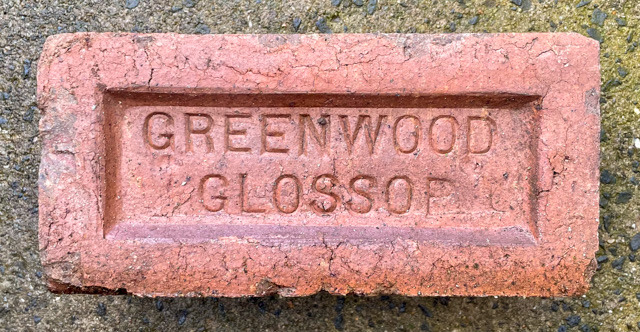
My first reference to this brickworks comes from Kelly's 1936 & 41 editions when John Greenwood (Brickworks) Co. Ltd. is listed at Railway Street, Glossop & works Monslow, Dinting, Glossop. From other information found I have established that the brickworks was at Mouselow Quarry although not marked as such on the 1938 map above. The 1879 map just shows a quarry with no buildings, then the 1897 map shows one building then the 1919 & 38 maps show two buildings & a tramway to the quarry face. Could these buildings be the brickworks ?

Photo by Frank Lawson.

Photo by Phil Burgoyne.

 Photo by MF courtesy of the Dave Penney Collection.

My second reference to a brickworks at Mouselow Quarry comes from a National Archives document which records an application by the Glossop Brickworks Ltd. to extract shale clay & brick earth from land adjoining Hounslow Quarry (this should read Mouselow) in 1958/9.


I expect this brick was made in the late 1950's/ early 60's by the Glossop Brickworks Co. Ltd. 

My next reference to this brickworks is in 1975 when J. & A. Jackson of Denton, Manchester are recorded as adding the Glossop works to their portfolio of owned brickworks. The brickworks may have closed under Jackson's ownership some time before 1994, as my final reference is the 2011 application by Wienerberger to continue extracting clay shale from their Mouselow Quarry until 2042 as originally approved in 1994. I have found that after Jackson's became the Chelwood Brick Co., this new company was later acquired/ taken over by Wienerberger resulting in Wienerberger owning the Mouselow Quarry today.


Many Thanks to
David Kitching
Frank Lawson
Dave Penney
Jason Stott
Trevor Wilson
Derby Silk Mill Museum
National Library of Scotland/ Ordnance Survey